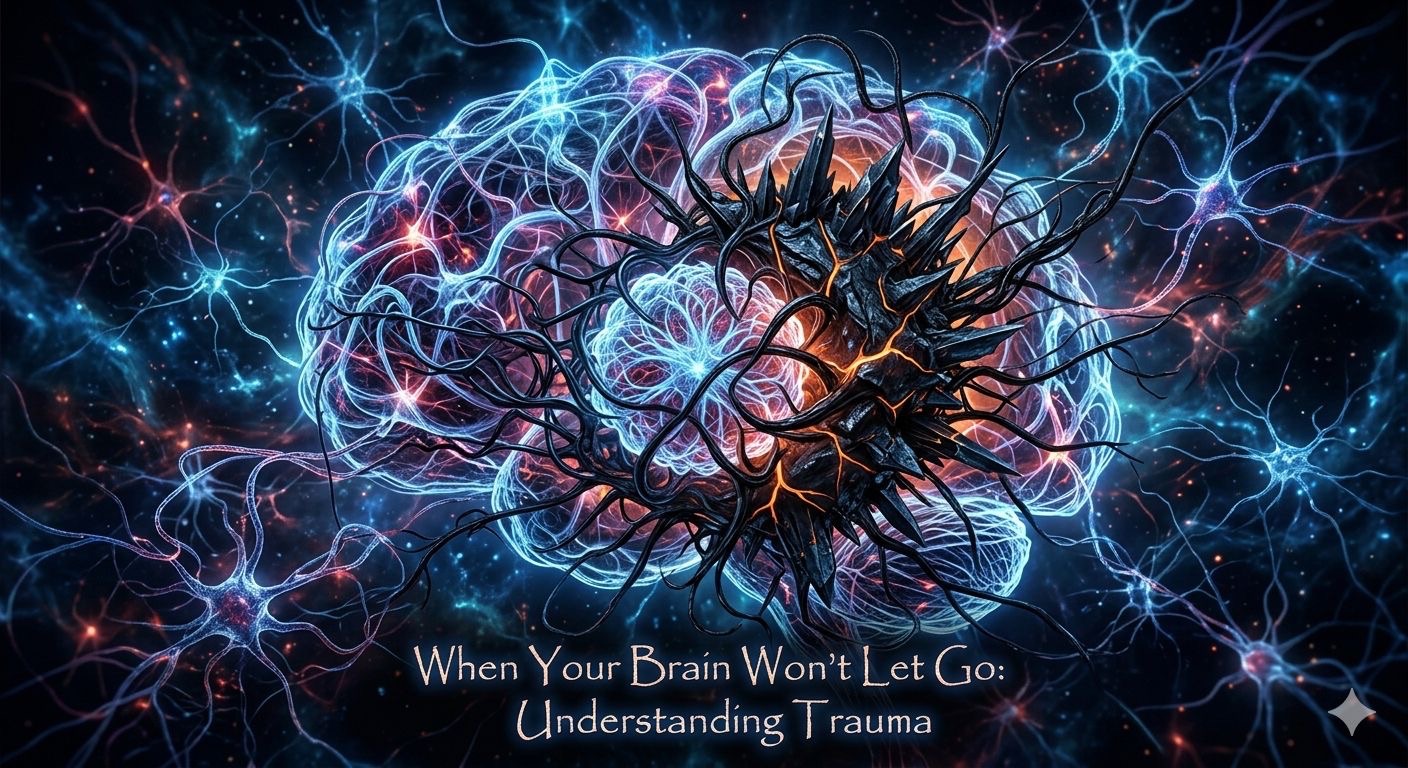
It is often assumed that trauma is just about “bad memories” of an experience or event. But trauma actually reshapes how your nervous system operates.
It can:
- Keep your brain in threat-detection mode (constantly scanning for danger)
- Strengthen pathways around fear, shame, or hypervigilance
- Weaken your ability to feel safe, present, or at peace
This involves things like:
- The amygdala becoming overactive
- The prefrontal cortex struggling to regulate emotions
- The hippocampus having difficulty placing experiences in the past
So your experience isn’t imagined—it’s wired in.
What happens to your brain after trauma
After trauma, the brain doesn’t just have negative thoughts—it defaults to them.
That’s because:
- Your amygdala is over-tuned to danger
- Your brain has learned: “It’s safer to expect the worst than to be caught off guard”
- Negative thought loops get reinforced simply because they are used more often
So it’s not that your mind is “choosing negativity”—it’s been trained into it.
What happens during emotional overwhelm
When you are in a state of hurt or sadness, your brain becomes overwhelmed and starts trying to survive what it perceives as ongoing danger.
When that happens, the brain—especially the amygdala—does something very specific:
- It locks you into the present pain
- It cuts off your ability to feel a sense of the future
- It makes everything feel permanent and inescapable
So when you hear something like,
“all ends well…”
your system rejects it—not because it’s universally false, but because your brain literally cannot access the concept of an “ending” in that moment. It’s in continuation mode, not resolution mode.
When this happens and you are in survival mode, it can feel like the end will never come.
That feeling is one of the most painful parts of trauma.
Not just the pain itself—but the sense that:
- it’s endless
- it’s closing in
- there’s no exit point
That’s not just emotional—that’s how a nervous system behaves when it has been under sustained strain for too long without relief.
Can your brain heal from trauma?
Yes, but it is not an easy process, especially without consistent effort.
- The brain can form new pathways
- Old trauma responses can weaken over time
- Safety, calm, and even joy can become more accessible again
But—and this matters—it’s not like deleting a file.
It’s more like building new roads so you don’t keep automatically taking the same painful route.
Healing usually looks like:
- Triggers becoming less intense
- Emotional waves becoming shorter
- You gaining more choice in how you respond
An honest version of healing
Healing from trauma often looks like:
- You still remember—but it doesn’t control your nervous system
- You still feel—but it doesn’t overwhelm you in the same way
- You still have difficult thoughts—but they don’t convince you they are permanent reality
And sometimes, you begin to experience moments of:
- real calm
- real presence
- real lightness
Not forced positivity—actual peace.
What shifts during healing
As healing happens (through time, repetition, safety, and sometimes therapy), something important changes:
- Negative thoughts become less automatic
- Neutral thoughts become more available
- Positive thoughts start to feel less foreign or forced
The key shift is this:
Your baseline moves from “mostly negative” → to “mostly neutral, with a mix of everything.”
And that “neutral” space is actually a big win. It’s where:
- your mind isn’t attacking you
- you’re not constantly bracing
- you can simply exist without internal pressure
Why neutral matters more than positive
A lot of people aim for “positive,” but the real turning point is when your mind stops being against you all the time.
Because:
- Constant positivity is unnatural
- Constant internal threat is a trauma pattern
So healing looks like:
- Fewer intrusive negative spirals
- Less emotional charge behind thoughts
- More mental “quiet” between them
Positive thinking can eventually outweigh negative thinking—but not when it’s forced.
How the shift usually unfolds
It often happens like this:
- Negative dominates
- Negative + neutral
- Mostly neutral
- Neutral + some genuine positive
- Positive thoughts begin to feel natural, not forced
And importantly:
- Negative thoughts don’t completely disappear
- They simply lose their authority
What people don’t say enough
There is usually a long period where:
- You’re not as overwhelmed as before
- But you’re also not where you want to be yet
That middle space can feel frustrating, because:
- old patterns still show up
- but you can see they’re not fully true anymore
That’s actually a sign that things are shifting.

Leave a Reply